
In this guide
A ring setting is the metal structure that holds and supports the gemstones. It determines how high the center stone sits, how much metal is visible, how the ring looks from the side, how easily it may snag, and whether a wedding band can sit closely beside it.
Stone shape describes the gemstone outline. Setting describes the ring architecture around it. The same oval, round, or emerald-cut moissanite can look and wear very differently in a solitaire, halo, bezel, three-stone, pavé, or split-shank design.
Use this guide to compare the most common moissanite engagement-ring settings, then browse the Moissanite Engagement Rings collection for finished examples.
Quick Setting Comparison
| Setting | Best known for | Main consideration |
|---|---|---|
| Solitaire | Clean focus on one center stone | Basket and profile determine wedding-band clearance |
| Cathedral | Raised shoulders supporting the center | Can add height and visible side structure |
| Halo | Accent stones surrounding the center from the top | More maintenance and a larger apparent footprint |
| Hidden halo | Side-view sparkle beneath the center | May affect basket width and band fit |
| Bezel | Metal rim around the stone | Shows more metal and changes the stone’s outline |
| Pavé | Fine sparkle along the band | Numerous small settings benefit from periodic inspection |
| Channel set | Accent stones between metal rails | More structured, linear appearance |
| Three-stone | Center stone with two prominent side stones | Greater width and more complex side structure |
| Side-stone | Additional supporting stones around the center | Stone arrangement can affect comfort and wedding-band fit |
| Split shank | Band divides into two visible paths | Creates more width across the top of the finger |
What Parts of a Ring Setting Matter?
Prongs
Prongs are small metal supports that hold the center or accent stones. Four prongs expose more of a round or oval stone and create a squarer visual outline. Six prongs can make a round stone appear more circular and distribute support across more points. Elongated and pointed shapes need prong placement that protects vulnerable tips without distorting the stone’s outline.
Prongs should be proportionate to the stone. They must provide support without appearing oversized or covering unnecessary surface area.
Basket
The basket is the structure directly beneath and around the center stone. Its width and height strongly influence the side profile and wedding-band clearance. A low basket keeps the stone closer to the finger but can block a straight wedding band. A raised basket may create more clearance, though the center stone will sit higher.
Gallery
The gallery is the side-facing area beneath the center setting. It may be simple and open, decorated with scrollwork or leaves, or accented with a hidden halo. The gallery affects the ring’s side appearance and can become a contact point for a neighboring wedding band.
Shoulders and Shank
The shoulders are the upper sections of the band approaching the center setting. The shank is the ring band itself. Cathedral shoulders rise toward the center, split shanks divide into two paths, and pavé or channel settings add stones along the shank. Width and thickness affect both visual balance and comfort.
Solitaire Settings
A solitaire places one center gemstone at the visual focus. It is the cleanest way to emphasize stone shape, faceting, and proportion. The term “solitaire” describes the one-center-stone composition, not one specific height or basket style.
Solitaire rings can be low or raised, plain or pavé, cathedral or non-cathedral, and four-prong or six-prong. Their relative simplicity makes them versatile, but a straight wedding band is not automatically guaranteed to sit flush. Basket width and setting height still control the fit.
Browse Solitaire Rings and compare the Round Moissanite Solitaire Ring, 2.5ct Oval Moissanite Solitaire Ring, and Emerald Cut Moissanite Solitaire Ring.
Cathedral Settings
A cathedral setting uses raised shoulders that sweep upward toward the center stone. The arches resemble the structural rise of cathedral architecture, which is why the setting has its name.
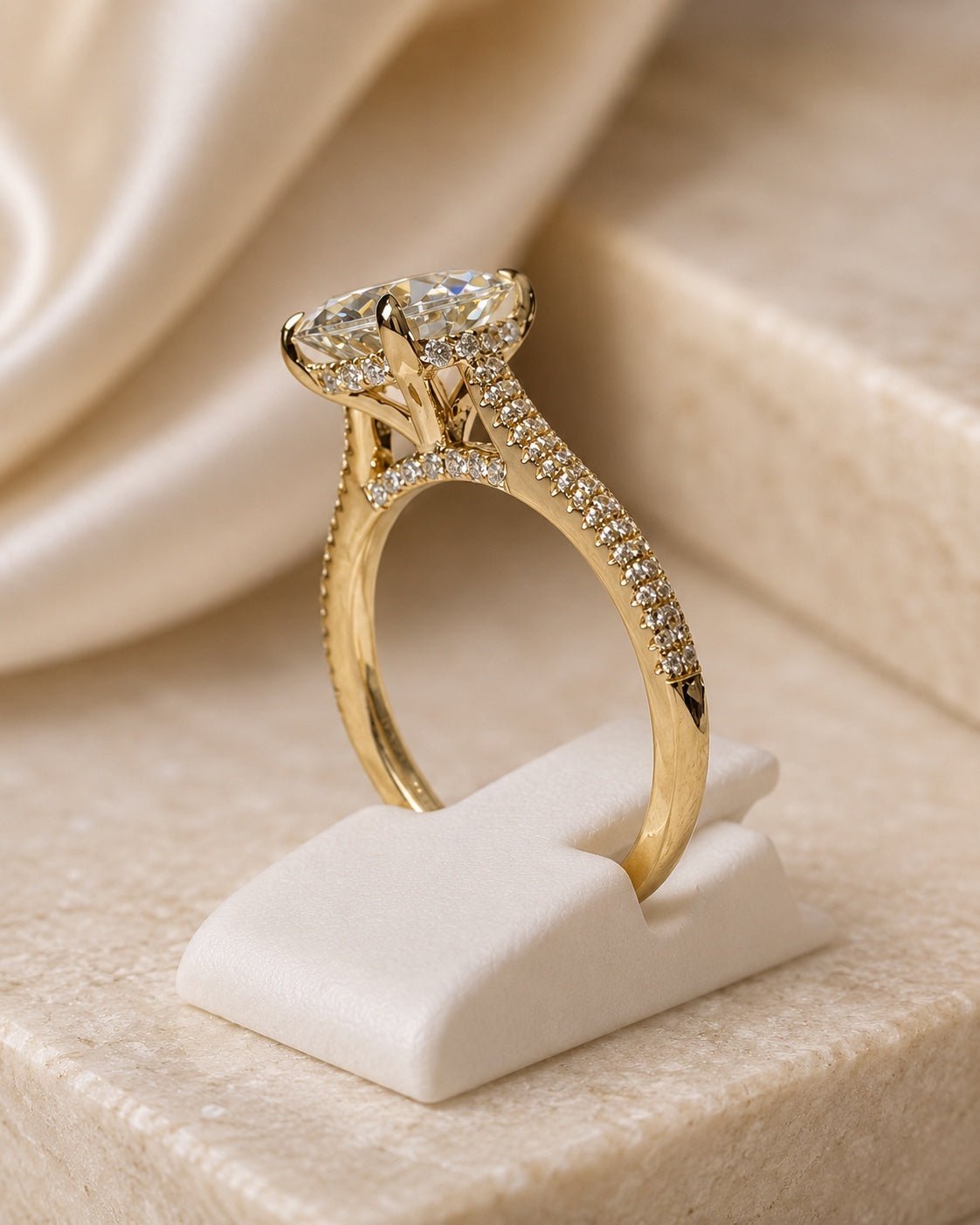
Cathedral shoulders can make a thin band feel visually connected to a larger center stone and can provide a graceful side profile. They do not automatically mean the ring is extremely high. The actual height depends on the basket, center size, and shoulder proportions.
A cathedral can be plain, pavé, hidden halo, or combined with side stones. When pairing a wedding band, check whether the raised shoulders and basket leave enough clearance for the neighboring ring.
Basket and Low-Profile Settings
A basket setting surrounds and supports the center stone from beneath. A low-profile basket holds the stone closer to the finger, which may reduce its exposed height. This can appeal to buyers who prefer a restrained silhouette or use their hands frequently.
The tradeoff is wedding-band clearance. A low basket often extends outward near the finger and may prevent a straight band from sitting close. A contour, chevron, open, or custom-fit band may be more appropriate.
Low profile should not be treated as universally superior. The best profile balances center-stone size, support, visual preference, comfort, and intended wedding-band pairing.
Halo Settings
A halo places smaller accent stones around the perimeter of the center stone. From the top, the halo creates a brighter border and increases the complete ring’s apparent footprint.
Halos can follow the center shape closely or create a contrasting outline. A round center may sit inside a round, cushion-shaped, floral, or geometric halo. The halo becomes part of the ring’s identity and can soften, sharpen, or enlarge the center silhouette.
The additional stones and settings require more cleaning and periodic inspection than a plain solitaire. A low halo may also interfere with a straight wedding band.
Browse Halo & Hidden Halo Rings and view the Round Moissanite Halo Pavé Ring.
Hidden Halo Settings
A hidden halo places small accent stones beneath the center stone rather than around its face-up perimeter. The ring can retain a relatively clean top view while adding side-profile detail and sparkle.
A hidden halo does not always remain completely hidden. Its visibility depends on the ring angle, height, basket diameter, and wearer’s hand position. It can make the center setting wider and may affect how closely a wedding band sits.
Compare the Round Moissanite Hidden Halo Ring.
Bezel Settings
A bezel setting surrounds all or part of a stone’s perimeter with metal. Full bezels create a continuous rim, while partial or half bezels leave sections of the stone exposed.
Bezel settings provide a smooth, defined outline and reduce the number of exposed prong tips. They are often chosen by buyers who prefer a clean modern structure or want fewer projecting elements.
The metal border changes the visual appearance of the stone and can make the setting feel more substantial. A bezel should be evaluated for proportion, center height, underside access for cleaning, and wedding-band clearance like any other setting.
Pavé and Micro-Pavé Settings
Pavé places small accent stones closely along the band or other ring surfaces. Micro-pavé uses especially small stones and fine setting work to create a delicate, continuous-looking surface of sparkle.
Pavé can support a solitaire, halo, split shank, three-stone, or vintage-inspired design. It increases brilliance without requiring larger side stones, but the numerous small settings need mindful wear and periodic inspection.
Remove delicate pavé rings before heavy lifting, strength training, gardening, or impact-prone activities. Clean carefully around and beneath the small stones where lotion and residue can collect.
Browse Pavé Rings and compare the Round Moissanite Pavé Solitaire Ring.
Channel-Set Settings
Channel-set accent stones sit between two metal rails. The rails create a structured, linear border and can provide a smoother outer edge than exposed shared prongs.
Channel settings work well for bands with repeated round, princess, baguette, or other calibrated stones. The design shows more continuous metal than pavé and often feels more architectural.
Because the stones must fit consistently within the channel, the setting is less visually airy than prong-set accents. Cleaning beneath the stones and evaluating ring-to-ring contact remain important.
Compare the Round Moissanite Channel-Set Engagement Ring and Round Three-Stone Moissanite Ring with Channel-Set Band.
Shared-Prong Settings
In a shared-prong setting, adjacent stones share some of the metal supports between them. This exposes more stone surface and creates an open, bright appearance.
Shared prongs are common in eternity bands, five-stone rings, halos, and accent rows. Their exposed structure should be protected from hard impact, and a neighboring ring should not rub directly against the shared-prong area.
Three-Stone Settings
A three-stone ring places one center stone between two prominent side stones. The side stones may match the center shape or create contrast through tapered baguettes, pears, marquise, trapezoids, or other cuts.
The composition creates more horizontal coverage than a solitaire and can make the ring feel complete without a halo. It is often associated with past, present, and future, although that meaning is optional rather than inherent.
Three-stone baskets and side prongs can affect wedding-band fit. Check the side profile and how far the stones extend toward neighboring fingers.
Browse Three-Stone Rings and compare the Emerald Cut Moissanite Ring with Baguette Side Stones and Round Moissanite Three-Stone Pavé Ring.
Side-Stone Settings
Side-stone settings use one or more accent stones to support the center. The category includes classic three-stone layouts, graduated arrangements, colored gemstone accents, tapered baguettes, clusters, and decorative pavé groups.
Side stones can broaden the ring, create a smooth transition from center to band, and introduce shape or color contrast. The complete arrangement should remain balanced and should not crowd neighboring fingers or create unnecessary setting height.
Browse Side Stone Rings and view the Marquise Moissanite Ring with Graduated Emerald-Cut Side Stones.
Split-Shank Settings
A split shank divides into two visible paths as it approaches the center setting. The open space can make the ring appear wider and more architectural without using one solid broad band.
Split shanks may be plain, pavé, halo, or side-stone designs. They can visually support a large center and create extra detail from the top view. Their greater width should be considered when choosing ring size, stack width, and a wedding band.
Browse Split Shank Rings and compare the Round Moissanite Halo Split-Shank Pavé Ring.
Nature-Inspired and Botanical Settings
Nature-inspired settings use leaves, vines, branches, petals, or other organic forms in the shank or gallery. The motif may be subtle and structural or become the main visual identity of the ring.
Botanical details can introduce open spaces, pointed leaves, small pavé accents, and irregular curves. These elements should remain readable and structurally believable rather than overly thin or decorative.
Browse Nature-Inspired Rings and compare the Round Moissanite Vine Engagement Ring and Emerald Cut Moissanite Leaf Ring.
Vintage-Inspired and Art Deco Settings
Vintage-inspired settings may use decorative galleries, milgrain-style texture, old-cut proportions, floral halos, or antique references. Art Deco settings emphasize geometry, symmetry, step-cut stones, fan motifs, and architectural contrast.
These are modern rings influenced by historical design languages. Unless a ring is a documented antique or reproduction of a verified design, it should not be described as historically authentic.
Browse Vintage-Inspired Moissanite Rings and Art Deco Rings. Compare the Art Deco Moissanite Halo Ring.
High-Profile vs. Low-Profile Settings
| Profile | Potential benefit | Potential tradeoff |
|---|---|---|
| Low profile | Center sits closer to the finger and may feel less exposed | Basket may block a straight wedding band |
| Medium profile | Balances visible height with moderate clearance | Exact fit still depends on basket and gallery width |
| High profile | More side clearance and a prominent center presentation | More exposed height and greater awareness during daily wear |
Height alone does not determine durability or comfort. Center size, basket design, prong placement, band width, hand shape, and wearer habits all matter.
How a Setting Affects Wedding-Band Fit
A straight wedding band can sit closely when the engagement-ring basket and gallery are raised or narrow enough to provide clearance. A low basket, broad halo, side stones, hidden halo, or sculptural shank can create a natural gap.
A gap is not automatically a flaw. The important questions are whether the spacing is intentional, whether the rings remain comfortable, and whether prongs or stones rub vulnerable areas of the neighboring ring.
Curved, contour, chevron, crown, open, or custom-fit bands may be used when a straight band cannot sit close. Read How to Choose a Moissanite Wedding Band and browse Moissanite Wedding Bands.
Best Setting by Priority
- Cleanest center-stone focus: solitaire
- Raised structural sweep: cathedral
- Larger face-up visual footprint: halo
- Subtle side sparkle: hidden halo
- Smooth metal outline: bezel
- Fine band sparkle: pavé or micro-pavé
- Structured linear accents: channel set
- Greater top-view width: three-stone or side-stone
- Open architectural band: split shank
- Organic detail: nature-inspired
- Geometric decorative detail: Art Deco
Setting Decision Checklist
- How high should the center stone sit?
- Will the ring be worn during hands-on work or frequent activity?
- How much cleaning and inspection is realistic?
- Should the center stone remain the sole focal point?
- Are pavé, halo, side stones, or decorative gallery details desired?
- Will a straight wedding band need to sit closely beside the ring?
- What total stack width will feel comfortable?
- Does the selected metal suit frequent wear and the intended wedding band?
- Are pointed stone tips and exposed settings appropriately protected?
Moissanite Ring Setting FAQs
What is the safest moissanite ring setting?
No setting is universally safest. A well-proportioned bezel reduces exposed stone edges, while a well-made prong setting provides secure support with less metal around the stone. Safety also depends on center size, stone shape, band structure, fit, and how the ring is worn.
What setting makes a moissanite look largest?
A visible halo can increase the complete ring’s apparent face-up footprint. Thin prongs and a narrow band may also make the center appear more prominent, but proportions should not be reduced beyond what the ring requires.
What is the difference between a halo and hidden halo?
A visible halo surrounds the center stone from the top. A hidden halo sits below the center and is seen mainly from the side.
Is a cathedral setting the same as a high setting?
No. Cathedral describes raised shoulders that sweep toward the center. The actual center height can still be low, medium, or high depending on the basket and stone.
Is a bezel setting good for daily wear?
A bezel can be a practical option because it surrounds more of the stone perimeter and has fewer projecting prong tips. The complete ring should still be removed during heavy lifting, impact-prone work, and other activities that could bend the band.
Does pavé make a ring less durable?
Pavé introduces many small stones and settings that require mindful wear and periodic inspection. Durability depends on the band dimensions, setting quality, stone layout, and wearer habits rather than the pavé label alone.
Which setting sits flush with a wedding band?
Raised baskets and galleries often provide more clearance, but no setting name guarantees flush fit. The exact basket width, prong placement, halo, side stones, and wedding-band profile must be considered together.
Can I change the setting on a finished Jewel Eternal design?
Many finished designs can be adjusted within practical structural limits. Setting height, prong style, band width, pavé, halo, side stones, and matching-band proportions may be discussed through a custom ring inquiry.