
In this guide
The best moissanite wedding band is the one that fits the engagement ring’s construction, feels comfortable at the total stack width, and uses a setting and metal suited to the wearer’s routine.
Appearance matters, but fit is determined by the basket, gallery, prongs, halo, band width, and setting height of the engagement ring. A wedding band does not have to sit completely flush, but any gap or contact should be understood before ordering.
Quick Answer
Start with the engagement ring’s side profile rather than its top view. A raised basket often leaves room for a straight wedding band, while a low basket, wide gallery, halo, or projecting prongs may require a curved, chevron, contour, open, crown, or custom-fit band.
Browse the Moissanite Wedding Bands collection while using the steps below to narrow the strongest fit.
1. Begin with the Engagement Ring’s Architecture
- Basket height: A raised basket may allow a straight band to pass beneath the center setting. A low basket usually blocks that path.
- Gallery width: A broad gallery or decorative profile can push a straight band away.
- Prong placement: Prongs that project outward can touch neighboring stones or metal.
- Halo or side stones: A halo, hidden halo, or low side baskets can require more clearance than a solitaire.
- Total width: Two comfortable rings can feel crowded when worn together.
Use clear side and three-quarter views. A top-down photograph can hide contact beneath the center setting.
2. Straight, Curved, Chevron, Crown, or Open?
| Band shape | Best suited to | Main consideration |
|---|---|---|
| Straight | Raised settings with adequate clearance and bands worn alone | May leave a gap beside a low basket or wide gallery |
| Curved or contour | Settings that need a shallow arc around the center | A highly specific curve may look less balanced alone |
| Chevron | Pointed or elongated centers and graphic stacks | The point must align with the engagement ring |
| Crown or tiara | Decorative bridal stacks and standalone shaped bands | Fit varies by crown height and basket profile |
| Open | Modern settings that need space around the center structure | Open ends need sufficient structure and alignment |
3. Does the Band Need to Sit Flush?
No. A small intentional gap can look balanced and may reduce direct contact between settings. The practical goal is to distinguish intentional spacing from unplanned interference.
A band that sits slightly apart without rubbing can be entirely appropriate. A band forced against prongs, pavé, or a gallery rail can create wear over time.
4. Check Ring-to-Ring Contact
Neighboring rings move independently. Contact can occur between prongs, pavé stones, gallery rails, milgrain edges, or polished shanks. Before choosing a band, check whether exposed stones face the engagement ring, whether prongs touch the neighboring shank, and whether one ring rides above or below the other.
A slim spacer band, different curve, or custom contour can reduce direct contact.
5. Compare Wedding-Band Styles
| Style | Appearance | Practical tradeoff |
|---|---|---|
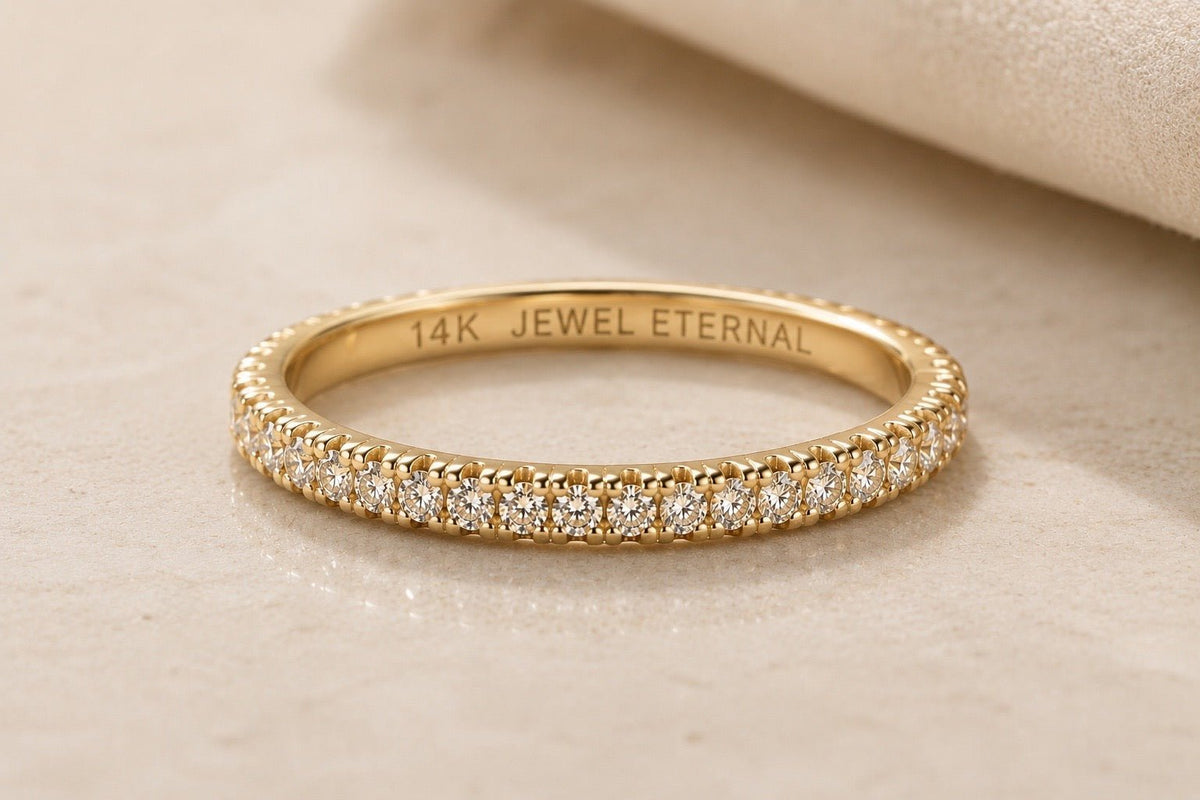
| Pavé or micro-pavé | A fine line of close-set sparkle | Small settings benefit from periodic inspection |
| Half eternity | Stones across the visible top with plain metal beneath | Usually more resizing flexibility than full eternity |
| Full eternity | Continuous stones around the complete ring | Limited resizing and more palm-side contact |
| Five-stone | Larger individual stones across the top | More width and height than fine pavé |
| Crown or contour | A shaped outline that frames the center setting | Exact spacing depends on the engagement ring |
| Multi-row | Strong finger coverage and concentrated brilliance | A wider, more substantial feel |
Compare the Micro Pavé Moissanite Half Eternity Band, 1.25ct Round Moissanite Five-Stone Band, and Marquise Moissanite Five-Stone Band.
6. Half Eternity vs. Full Eternity
A half-eternity band concentrates stones where they are most visible and leaves more uninterrupted metal beneath the finger. A full-eternity band provides uninterrupted sparkle but requires greater confidence in ring size because stones and settings continue around the complete circumference.
7. Choose Stone Scale and Total Stack Width
Judge the engagement ring and wedding band as one composition. Small accent stones generally preserve the engagement ring as the focal point. Larger stones add individual flashes and more finger coverage. Wider bands can fit more snugly, so sizing should account for the complete stack.
8. Understand the Setting
- Pavé: Small stones set close together for a fine surface of sparkle.
- Shared prong: Adjacent stones share setting elements, exposing more of each stone.
- Channel set: Stones sit between metal rails for a smoother linear profile.
- Bezel set: Metal surrounds each stone’s perimeter.
- Individual prong set: Larger stones are held separately, common in five-stone and graduated bands.
No setting is universally best. Stone size, band width, desired appearance, and daily routine determine the strongest choice.
9. Choose the Metal for the Intended Wear
- Rhodium-plated 925 sterling silver: An accessible bright white-metal option. Rhodium is a surface finish and can gradually wear.
- 925 sterling silver with 3 μm of 14K yellow-gold plating: A warm gold finish over sterling silver. It is best suited to lighter or occasional wear because the gold color is a surface layer.
- Solid 14K gold: A practical fine-jewelry foundation for frequent wear.
- Platinum 950: A naturally white, substantial premium metal often chosen for long-term bridal wear.
When two rings remain in constant contact, matching or compatible metals can simplify maintenance. Compare the plated option with plain silver in 14K Gold over Silver vs Sterling Silver Jewelry.
10. Pairing Guidance by Engagement-Ring Style
- Solitaire: Often compatible with a straight band when the basket is raised.
- Halo: A curved or custom band may be needed when the halo extends beyond the shank.
- Hidden halo: Clearance depends on the hidden halo’s diameter and height.
- Three-stone or side-stone: Side baskets and prongs often control spacing.
- Pear or marquise: A chevron, crown, or contour may echo the pointed silhouette.
- Low profile: Frequently requires a shaped or custom-fit band.
For shaped options, compare the Heritage Crown, Contour Crown, and Gaelic Crown.
11. Can a Wedding Band Be Worn Alone?
Yes. Pavé, five-stone, eternity, crown, and sculptural bands can function as standalone rings. Choose a design that looks complete without depending on the engagement ring if it will frequently be worn alone.
12. Care
Clean with warm water, mild soap, and a soft brush, then dry with a lint-free cloth. Remove the ring before heavy lifting, strength training, gardening, swimming, or work that could bend the band or strike the settings. Frequently worn prong and pavé bands should be inspected periodically.
Decision Checklist
- Can a straight band clear the basket and gallery?
- Do you want flush fit, intentional spacing, or a visibly shaped stack?
- Will stones, prongs, or edges rub the engagement ring?
- What is the combined width of both rings?
- Will the band be worn alone?
- Is future resizing important?
- Is the metal appropriate for the intended wear?
Frequently Asked Questions
Is moissanite suitable for a wedding band?
Yes. It works well in pavé, eternity, five-stone, crown, contour, and stackable bands when the complete construction suits the intended wear.
What band works with a low basket?
A curved, contour, chevron, open, or custom-fit band is often more compatible than a straight band.
Which wedding band is easiest to resize?
Plain and half-eternity bands generally offer more flexibility than full-eternity bands.
Can I choose the band after buying the engagement ring?
Yes. Use clear top, side, and three-quarter photographs plus measurements when assessing fit, or submit a custom ring inquiry.