
Moissanite Engagement Ring Buying Guide
Find the ring that feels like you
Choosing a moissanite engagement ring is easier when you separate the decision into six parts: stone shape, stone size, setting style, metal, lifestyle, and wedding-band fit.
The strongest ring is not automatically the largest or most detailed. It is the design that looks balanced on the hand, supports the center stone properly, suits the wearer’s routine, and still feels personal years from now.
In this guide
Quick Answer
Start with the center-stone shape, then choose a setting that supports that shape and fits the wearer’s lifestyle. Compare millimeter dimensions rather than relying only on carat-equivalent labels. Select a realistic metal and band width, confirm the ring size, and plan the wedding band before production when a close or flush stack matters.
Step 1: Choose the Stone Shape
Round Moissanite
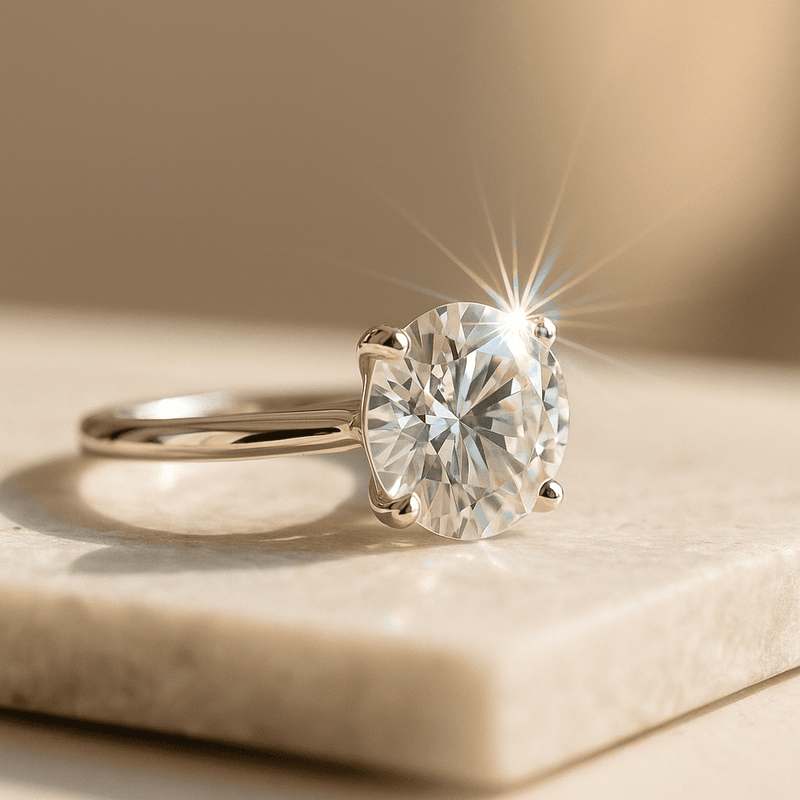
Round moissanite is symmetrical, bright, and classic. It is a reliable choice when you want crisp brilliance and a design that works across many setting styles.
Browse Round Moissanite Rings.
Oval Moissanite
Oval moissanite creates a longer line on the finger and often shows strong face-up spread. Brilliant faceting gives crisper flashes, while crushed-ice faceting creates a softer, more diffused pattern.
Browse Oval Moissanite Rings.
Emerald Cut Moissanite
Emerald cut moissanite has long step facets and broad flashes rather than constant glitter. It is a strong choice for buyers who prefer clean lines, architectural structure, and quiet-luxury styling.
Browse Emerald Cut Moissanite Rings.
Cushion Cut Moissanite
Cushion cut moissanite combines a square or rectangular outline with softened corners. It can feel romantic, vintage-inspired, or modern depending on its proportions and faceting.
Browse Cushion Cut Moissanite Rings.
Pear, Marquise, Radiant, Princess, and Asscher
Pear and marquise create directional length and need secure protection at their pointed tips. Radiant cuts combine a structured outline with brilliant sparkle. Princess cuts feel crisp and modern. Asscher cuts have square step-cut geometry and a restrained Art Deco character.
Use the Moissanite Ring Shape Comparison Guide for a fuller comparison.
Step 2: Compare Millimeter Size, Not Only Carat Equivalent
Moissanite is commonly described with diamond-equivalent carat language, but millimeter dimensions show the actual face-up length and width. Two stones with the same general carat-equivalent label can look different because shape, depth, ratio, and faceting vary.
The best size depends on finger dimensions, band width, setting height, stone shape, daily routine, and preferred visual presence. A larger stone can still look refined when the complete setting remains proportionate.
See the Moissanite Stone Size Guide and Moissanite Carat Size vs Millimeter Size.
Step 3: Choose the Setting Style
Solitaire
A solitaire keeps the center stone as the only major focal point. It is generally the easiest to clean and one of the most flexible styles for wedding-band pairing.
Browse Solitaire Rings.
Hidden Halo
A hidden halo places small accent stones beneath the center, adding detail from the side while preserving a cleaner top view. It requires more inspection and cleaning than a plain solitaire.
Visible Halo
A visible halo surrounds the center stone with smaller stones. It creates a brighter perimeter and can make the complete face-up composition look larger.
Browse Halo & Hidden Halo Rings.
Cathedral
A cathedral setting uses shoulders that rise toward the center. It can add support and a more integrated side profile, particularly for larger stones or slender-looking bands.
Bezel
A bezel surrounds part or all of the stone with metal. It creates a smooth modern profile and can protect exposed edges, though it changes how much of the stone’s outline remains visible.
Three-Stone and Side-Stone
A three-stone setting adds one prominent stone on each side of the center. Side-stone proportion is critical because the accents should support rather than overpower the main stone.
Browse Three-Stone Rings and Side-Stone Rings.
Pavé and Channel Set
Pavé places small stones closely along the band for a fine line of sparkle. Channel-set stones sit between metal walls for a smoother, more structured presentation. Both add detail, but pavé generally has more exposed small settings to inspect.
Best Style by Priority
- Most timeless: round, oval, or emerald cut solitaire
- Most brilliance from the center: round brilliant solitaire
- Most finger coverage: oval, marquise, pear, or elongated cushion
- Most architectural: emerald cut or Asscher
- Best subtle detail: restrained hidden halo
- Largest face-up effect: visible halo
- Most symbolic: three-stone
- Most protective modern profile: bezel
Step 4: Choose the Metal
Metal changes the ring’s color, weight, maintenance, price, and long-term wearability.
- Solid 14K yellow gold: warm, classic, and practical for frequent wear.
- Solid 14K white gold: bright and crisp, with maintenance needs that depend on the alloy and finish.
- Solid 14K rose gold: soft and warm, with a distinctive blush tone where offered.
- Platinum 950: substantial, naturally white, and premium in weight and price.
- 925 sterling silver: accessible and attractive, but generally softer and more maintenance-sensitive than solid gold or platinum.
- 925 sterling silver with 3 μm of 14K yellow-gold plating: a warm gold surface over sterling silver. The finish should be protected from abrasion, chemicals, and prolonged moisture.
For frequent long-term engagement-ring wear, solid 14K gold or Platinum 950 generally provides the strongest Jewel Eternal foundation among the listed options.
Step 5: Match the Ring to the Wearer’s Lifestyle
A ring should fit the way it will actually be worn. Hands-on work, workouts, gardening, travel, childcare, and tolerance for maintenance can all affect the strongest setting.
- Choose secure prongs or a bezel for active hands.
- Use enough band and basket structure for a substantial center stone.
- Consider a lower profile when snag resistance matters.
- Expect more inspection with pavé, halo, and multi-stone settings.
- Remove the ring during heavy lifting, workouts, swimming, cleaning, or activities that may bend the setting.
Step 6: Plan the Wedding Band
Some engagement rings allow a straight band to sit close. Others leave a small gap or require a curved, chevron, crown, open, or custom-fit band because of the basket, gallery, halo, side stones, or setting height.
Planning the full bridal set before production is the most reliable way to control spacing, rubbing points, and total width. Browse Moissanite Wedding Bands and read How to Choose a Moissanite Wedding Band.
Ready-to-Ship, Made-to-Order, or Custom?
Ready-to-ship jewelry is best when timing is the priority. Made-to-order products use established designs with selected options. Custom is most useful when stone dimensions, band width, setting height, side stones, prongs, or wedding-band fit must be changed.
Custom does not always require starting from a blank page. An existing design can often serve as a structurally proven foundation and be adjusted around the details that matter most.
Read the Custom Ring Design Guide or start a custom ring inquiry.
Common Buying Mistakes
- Choosing only by carat-equivalent label instead of millimeter dimensions
- Selecting the largest stone without considering hand and setting proportions
- Choosing a band that is too slight for the center stone
- Reviewing only the top view and ignoring the basket and gallery
- Forgetting wedding-band clearance
- Assuming all cuts of the same shape have the same light pattern
- Combining too many halos, side stones, pavé, and sculptural details in one design
- Starting a custom project too close to a fixed date
Frequently Asked Questions
Is moissanite suitable for engagement rings?
Yes. Moissanite is durable, bright, and suitable for engagement rings when the complete setting is designed and maintained appropriately.
What is the most timeless engagement-ring style?
A well-proportioned solitaire is generally the most adaptable because the design remains centered on the stone and construction.
What moissanite shape looks largest?
Oval, marquise, pear, and elongated cushion shapes often create more face-up spread than round stones of similar carat equivalent.
Which metal is best for frequent wear?
Solid 14K gold and Platinum 950 generally provide the strongest long-term Jewel Eternal foundation among the listed options.
How early should I start a custom engagement ring?
Start as early as possible. Design clarification, CAD or approval, stone sourcing, production, finishing, review, and shipping all require time.