
In this guide
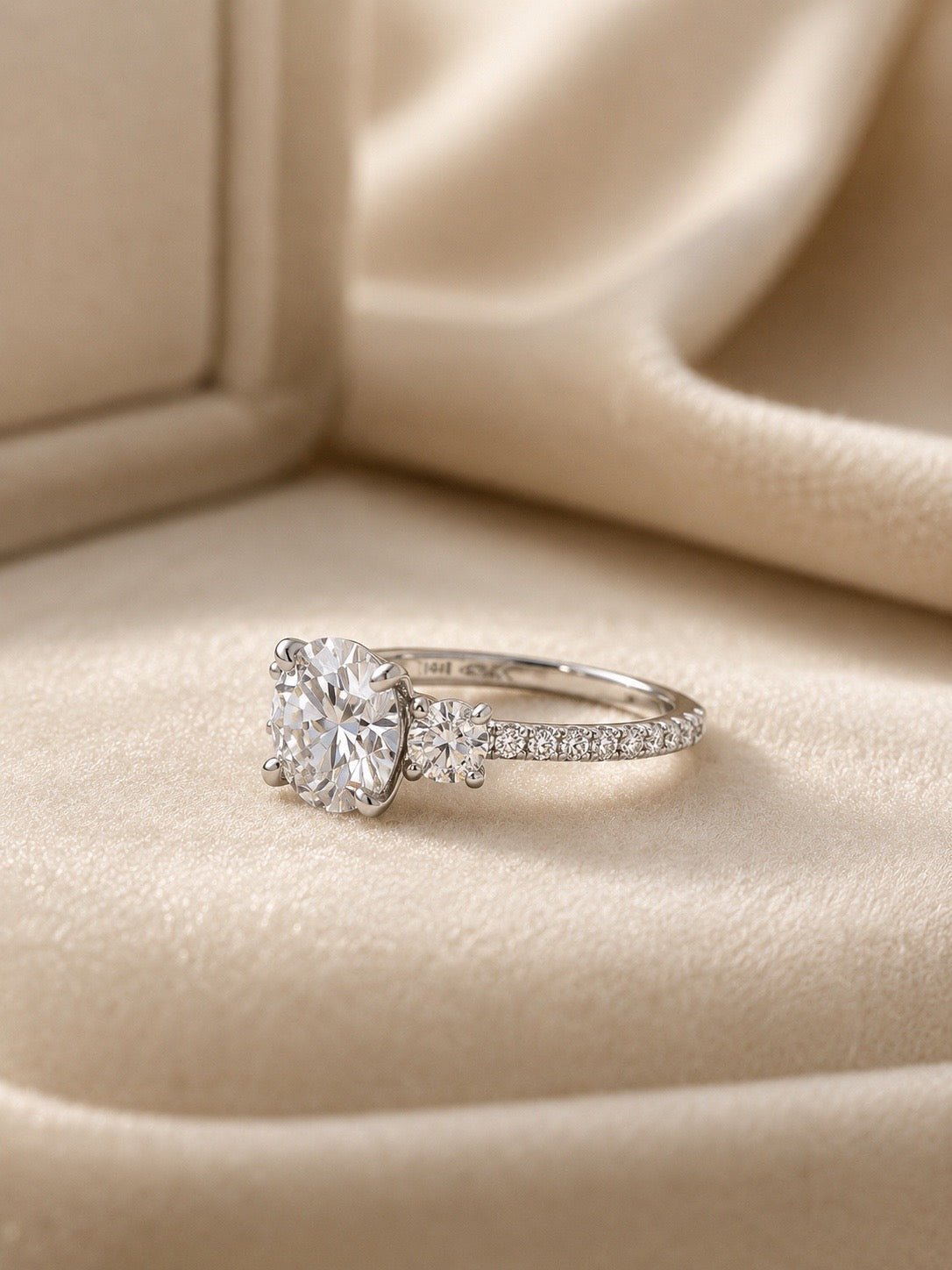
A three-stone ring has one center stone with one side stone on each side. The design creates more width across the finger than a solitaire and can make an engagement, anniversary, or milestone ring feel substantial without relying on a halo.
Three-stone rings can look classic, architectural, romantic, or vintage-inspired depending on the stone shapes, side-stone proportions, setting height, band style, and metal.
To compare current designs, explore three-stone moissanite engagement rings by center shape, side-stone arrangement, and band style.
Quick Answer
Choose a three-stone ring if you want more presence than a solitaire, visible side stones, and a balanced design. The center stone should remain the focal point while the two side stones add width and support its shape.
What Does a Three-Stone Ring Symbolize?
Three-stone rings are often associated with a relationship’s past, present, and future. They can also represent three family members, milestones, years, or personal values.
The symbolism is optional. Many buyers choose the layout simply because it creates a complete, balanced top view and more finger coverage than a solitaire.
How a Three-Stone Ring Works
The center stone remains the main focus, while the two side stones add width and detail. The side stones can match the center shape or use a contrasting shape that guides the eye toward it.
Proportion is the most important design factor. Side stones should support the center rather than compete with it. The transition from the center stone into the side stones and band should feel deliberate from both the top and side views.
Three-Stone vs Solitaire Rings
| Feature | Three-Stone Ring | Solitaire Ring |
|---|---|---|
| Stone layout | One center stone with two side stones | One center stone |
| Visual width | More coverage across the finger | Cleaner and more minimal |
| Maintenance | More stones and setting points | Generally simpler to clean and inspect |
| Style feel | Detailed and substantial | Classic and restrained |
| Best for | Balanced presence and symbolism | Center-stone focus |
Best Center Stone Shapes
- Round: classic brilliance and traditional symmetry
- Oval: elongated softness and broad finger coverage
- Emerald cut: clean step-cut geometry and quiet-luxury structure
- Cushion: rounded-square softness and romantic character
- Pear: directional movement and a distinctive silhouette
- Radiant: structured outline with brilliant sparkle
- Old European cut: broader antique-inspired flashes and vintage character
Common Side-Stone Shapes
Side stones can be round, pear, marquise, tapered baguette, trapezoid, oval, or smaller versions of the center stone shape. The best side stone depends on the center stone and the intended style.
Emerald cut centers pair naturally with tapered baguettes or other step-cut accents because the facets and edges repeat the same architectural language. Round centers coordinate easily with round side stones. Oval and pear centers can work with rounded or tapered side stones when their proportions remain balanced.
Round Three-Stone Moissanite Rings
Round three-stone rings create classic sparkle and a familiar bridal profile. They are strong choices when you want a timeless ring with more substance than a simple solitaire.
Emerald Cut Three-Stone Moissanite Rings
Emerald cut three-stone rings feel more architectural and restrained. Baguette side stones are especially effective because they extend the center’s linear step-cut geometry into the band.
Vintage-Inspired Three-Stone Rings
Old European cut centers and marquise accents create a softer, more antique-inspired profile than modern brilliant-cut arrangements. These designs are suited to buyers who want vintage character without purchasing a fragile antique setting.
Compare the Old European Cut Moissanite Three-Stone Ring.
Gemstone Three-Stone Rings
A three-stone layout can also use sapphire, ruby, or other gemstone accents. Colored side stones create contrast while allowing the center moissanite to remain bright and recognizable.
See the 3ct Round Moissanite Ring with Sapphire or Ruby Side Stones and the East-West Oval Sapphire Three-Stone Ring.
Why Choose a Three-Stone Moissanite Ring?
Moissanite works well in three-stone rings because it offers visible brilliance in a range of shapes and sizes. The layout can create a strong statement through proportion and width instead of relying only on an oversized center stone.
This makes the style useful for engagement rings, anniversary upgrades, milestone rings, and custom designs where the side stones can be tailored to the wearer’s preferences.
Three-Stone Rings as Anniversary or Milestone Rings
Three-stone rings are frequently chosen for anniversaries because the symbolic layout and additional presence make them feel distinct from an original solitaire or wedding band.
They can be worn as a right-hand ring, anniversary upgrade, engagement ring, or commemorative piece. Read the Moissanite Anniversary Ring Guide for more options.
Three-Stone Ring Proportions
Proportion matters more than simply choosing large side stones. If the side stones are too large, the composition can look crowded and the center loses its role. If they are too small or far away, they may look disconnected.
A refined three-stone ring should have a clear center stone, supportive side stones, smooth visual transitions, and a setting that does not look unnecessarily bulky from the side.
Daily Wear Considerations
Three-stone rings can be worn daily when built well, but they have more stones, prongs, and setting points than a solitaire.
- Check the center and side-stone prongs periodically.
- Clean beneath all three stones where residue can collect.
- Use enough band and basket structure for the total stone scale.
- Remove the ring during heavy lifting, workouts, gardening, swimming, and household cleaning.
- Avoid adding unnecessary halo or pavé detail when lower maintenance is a priority.
Wedding Band Fit
A three-stone ring may or may not sit flush with a straight wedding band. Side-stone width, basket shape, setting height, and gallery construction can all affect the fit.
Plan the wedding band before finalizing the engagement ring when a seamless stack is important. A curved, chevron, crown, or custom-fit band may provide better clearance than a straight band.
Best Choice by Style
- Most classic: round center with round side stones
- Most architectural: emerald cut center with baguette side stones
- Most romantic: Old European cut with marquise accents
- Most personal color contrast: moissanite center with sapphire or ruby side stones
- Best milestone style: a balanced three-stone anniversary ring
Common Three-Stone Ring Mistakes
- Choosing side stones that overpower the center stone.
- Ignoring the side profile and setting height.
- Adding too many design details at once.
- Forgetting to plan wedding-band fit.
- Choosing a very thin band without enough structure for the complete setting.
- Comparing only carat-equivalent labels instead of the actual dimensions of all three stones.
Who Should Choose a Three-Stone Ring?
A three-stone ring is best for someone who wants more presence than a solitaire while keeping the design structured and intentional. It is a strong choice for buyers who value balanced detail, finger coverage, symbolism, or custom side-stone combinations.
If you want the simplest possible ring, a solitaire may be better. If you want a brighter outline around one center stone, a halo may be more appropriate.
Frequently Asked Questions
What is a three-stone ring?
A three-stone ring has one center stone with one side stone on each side.
Is a three-stone ring good for engagement rings?
Yes. Three-stone rings can make excellent engagement rings when the stones are proportioned well and the setting is built securely.
Does a three-stone ring look bigger than a solitaire?
Often, yes. The side stones add width across the finger, which can make the complete ring look more substantial.
What stone shape is best for a three-stone ring?
Round, oval, emerald cut, cushion, pear, radiant, and antique-inspired stones can all work well. The best choice depends on the desired style and side-stone pairing.
Can a wedding band sit flush with a three-stone ring?
Sometimes. It depends on the setting height, side stones, basket shape, gallery, and band design.
Can a three-stone ring be customized?
Yes. Center and side-stone shapes, dimensions, metal, setting height, band width, and wedding-band fit can be adjusted subject to feasibility and final pricing.