
In this guide
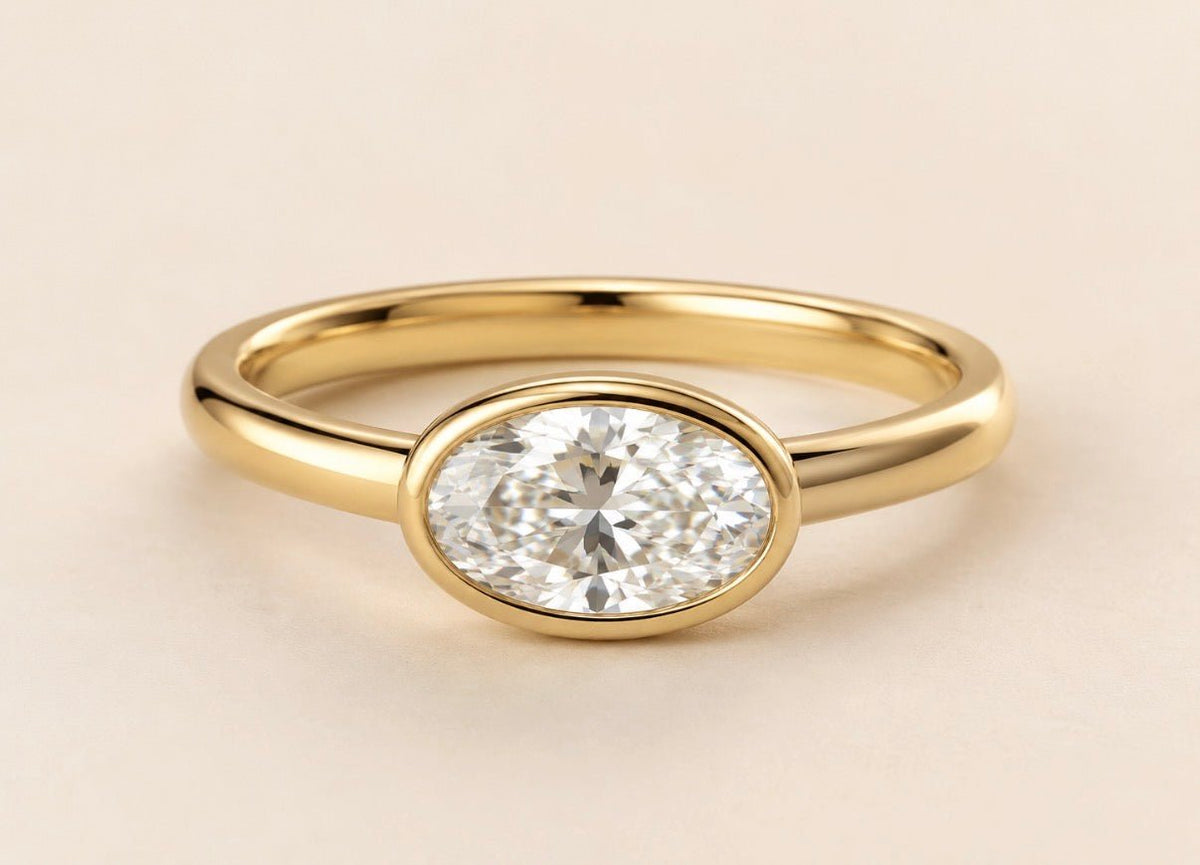
Example situation: A buyer wants a modern moissanite engagement ring with a distinctive horizontal silhouette, warm yellow gold, a low-profile feel, no pavé, and a smooth setting suited to frequent wear.
The proposed direction is an east-west oval moissanite in a full bezel setting with a plain approximately 2.2mm band. The value of this example is not the individual ring alone. It shows how each design choice affects scale, comfort, maintenance, structure, and wedding-band compatibility.
Starting Priorities
- Look: modern, refined, and minimal
- Center stone: approximately 2.5ct-equivalent oval colorless moissanite
- Orientation: east-west
- Setting: full bezel with a low-profile direction
- Metal: solid 14K yellow gold
- Band: plain, approximately 2.2mm wide, with a comfortable profile
- Wear priorities: reduced snag risk, easier maintenance, comfort, and a secure center-stone setting
- Details to avoid: halo, hidden halo, pavé, side stones, a very high setting, or an overly delicate band
Design Decision 1: Turn the Oval East-West
An east-west oval sits horizontally across the finger instead of running lengthwise. This creates width and a distinctly modern silhouette without relying on a halo or side stones.
The orientation changes more than appearance. The stone's millimeter width, length-to-width ratio, finger coverage, bezel thickness, and wedding-band clearance must be considered together. A carat-equivalent label is only a starting point because oval stones with the same label may have different dimensions and proportions.
Main benefit: distinctive finger coverage with a clean, minimal design.
Main tradeoff: the wider setting can make wedding-band fit and overall scale more sensitive to exact dimensions.
Design Decision 2: Use a Full Bezel
A full bezel creates a smooth outline around the oval and covers more of the stone's edge than an open prong setting. It supports the goal of reducing snag points while giving the horizontal stone a deliberate architectural frame.
The bezel should not be treated as a purely decorative border. Its thickness affects how large the center appears, how much metal is visible, how light enters the stone, and how refined or heavy the finished ring feels.
Main benefit: smoother edges, visual definition, and more protection around the stone's perimeter.
Main tradeoff: a bezel can make the center appear slightly smaller and may require careful proportioning to avoid a bulky look.
Design Decision 3: Keep the Profile Low, but Not Impossibly Low
A lower setting can feel more practical for frequent wear, but the stone depth, bezel structure, bridge, and wedding-band plan determine how low the ring can realistically sit.
Lower is not automatically better. If the center is pushed too close to the finger, the setting may interfere with a wedding band, limit cleaning access, or require structural compromises. The goal is a balanced profile that feels streamlined while preserving proper construction and wearability.
Design Decision 4: Pair the Center with a Plain 2.2mm Band
An approximately 2.2mm plain band gives the horizontal center enough visual support without making the ring feel heavy. A significantly thinner band could appear disconnected from the width of the bezel and may not suit the intended frequent-wear use.
Keeping the band plain also supports easier maintenance and preserves the minimal design. Final width, thickness, taper, and comfort profile would be confirmed with the ring size and center-stone dimensions rather than selected independently.
Design Decision 5: Plan the Wedding Band Before Finalizing the Ring
A straight wedding band may sit closely, leave a small intentional gap, or require a subtle contour depending on the bezel, bridge, setting height, and band profile.
Flush fit should never be assumed from the top view alone. A side profile is essential when a buyer has a strong preference about stacking. In this example, the wedding-band relationship would be reviewed before the engagement-ring specifications are approved.
Recommended Design Direction
- East-west oval moissanite selected by millimeter dimensions and proportion, not carat-equivalent label alone
- Full bezel with a refined edge and balanced metal presence
- Solid 14K yellow gold
- Low-profile direction, subject to the stone depth and final structure
- Plain approximately 2.2mm band with a comfortable profile
- No halo, hidden halo, pavé, or side stones
- Wedding-band fit evaluated before approval
What Would Still Need to Be Confirmed
A strong design direction is not yet a complete order specification. Before a similar ring could proceed, the following would still need confirmation:
- Exact oval millimeter dimensions and length-to-width ratio
- Ring size and intended finger coverage
- Bezel thickness and visible metal proportion
- Final band width, thickness, taper, and profile
- Setting height and under-gallery structure
- Straight, contoured, or intentionally spaced wedding-band preference
- Stone and metal availability
- Final feasibility, price, payment terms, and made-to-order timing
Who This Design Direction Suits
This approach is a strong fit for someone who wants a modern alternative to a traditional north-south solitaire, prefers smooth lines over exposed prongs, and values a clean design with reduced snag points.
A different direction may be better for someone who wants maximum visible stone size, a very delicate band, a guaranteed flush straight wedding band, or the most open light exposure around the center. In those cases, a prong setting, higher profile, north-south orientation, or different basket structure may be more appropriate.
How to Use This Example for Your Own Ring
Do not begin by copying every specification. Begin by identifying the priorities that matter most:
- Do you want length along the finger or width across it?
- Do you prefer exposed prongs or a smoother bezel outline?
- Is a low profile more important than a guaranteed close wedding-band fit?
- Do you want a plain band for lower maintenance or accent stones for added brilliance?
- Which details are essential, and which can change if they improve comfort or structure?
For additional planning, read the Custom Moissanite Ring Design Guide, the Moissanite Ring Settings Guide, and the Moissanite Shape Comparison Guide.
Start a custom moissanite ring inquiry
Frequently Asked Questions
Can a similar east-west oval bezel ring be requested?
A similar direction may be considered. Exact availability, dimensions, materials, structure, feasibility, pricing, and timing must be confirmed for the individual request.
Will an east-west bezel ring sit flush with a straight band?
Not automatically. Wedding-band fit depends on the final bezel, bridge, setting height, stone depth, and band profile. A small gap or contour may be necessary.
Can the shape, metal, or band width be changed?
Other combinations may be considered when feasible. Each change should be evaluated as part of the complete ring because it can affect scale, structure, comfort, maintenance, and wedding-band compatibility.
Note: This is an illustrative design example, not a completed customer project. Exact specifications and availability are confirmed separately for each request.